
Unlocking Potential: How Neuroplasticity Transforms Learning Disabilities into Opportunities
- Stephanie Anderson

- May 8
- 3 min read
Updated: May 13
Learning disabilities often feel like permanent barriers, but recent neuroscience shows a different story. These challenges are not fixed traits but reflections of how the brain is currently wired. From a neurodevelopment perspective, difficulties with reading, memory, attention, or processing stem from underdeveloped neural pathways rather than a lack of ability. The brain’s remarkable capacity to change itself, known as neuroplasticity, offers hope and practical ways to build stronger cognitive skills.
How the Brain Changes Through Experience
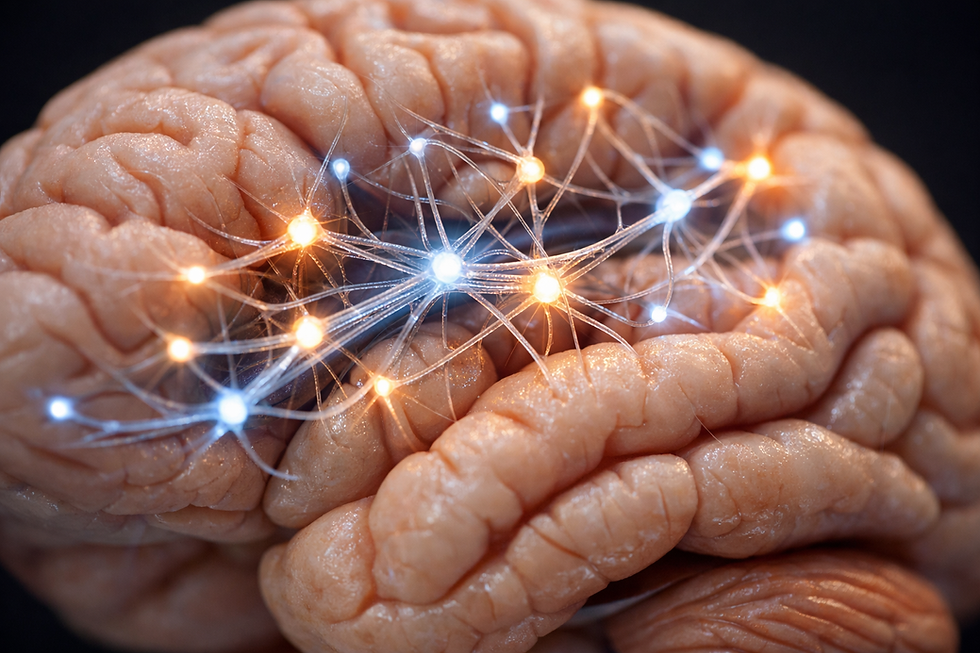
The brain adapts through use. Every time you perform a task—such as reading a word, recalling a sequence, or interpreting a sound—neurons fire in specific patterns. When these patterns repeat, the connections between neurons strengthen, signals travel faster, and processing becomes more automatic. This process, called Long-Term Potentiation (LTP), forms the biological basis of learning.
For example, a child struggling to read may have weaker connections in areas responsible for language processing. Repeated practice with targeted reading exercises stimulates these neural pathways, gradually strengthening them. Over time, this leads to improved reading fluency and comprehension.
Understanding Neural Pathways and Their Role
Neural pathways are the routes through which information travels in the brain. Learning a new skill or performing a task activates specific neurons in a coordinated sequence. When these neurons fire together repeatedly, their synaptic connections grow stronger and more efficient. This physical change in the brain’s wiring supports faster and more accurate information processing.
Consider attention difficulties. Instead of seeing them as fixed limitations, they reflect underdeveloped pathways in brain regions that regulate focus. Through exercises designed to improve attention—such as mindfulness practices or cognitive training—these pathways can be strengthened, leading to better concentration and task management.
Neuroplasticity Means Learning Disabilities Are Not Permanent
For decades, scientists believed the adult brain was mostly fixed after childhood. Modern research has overturned this idea, showing the brain remains adaptable throughout life. This means learning disabilities are not permanent deficits but current states of neural connectivity that can improve with intentional, repetitive stimulation.
This perspective shifts the focus from working around limitations to actively building the brain’s capacity. Instead of accepting difficulties as unchangeable, targeted interventions can help the brain reorganize and develop new pathways, improving skills over time.
Practical Approaches to Harness Neuroplasticity
To support neuroplasticity in learning disabilities, interventions should focus on:
Repetition: Consistent practice strengthens neural connections.
Targeted stimulation: Exercises should focus on specific skills that need development.
Multisensory learning: Engaging multiple senses enhances neural activation.
Incremental challenges: Gradually increasing task difficulty encourages growth without overwhelming.
Feedback and motivation: Positive reinforcement supports continued effort and engagement.
For example, a student with memory challenges might use spaced repetition techniques, reviewing information at increasing intervals to reinforce neural pathways. A learner with processing speed difficulties could benefit from timed exercises that gradually increase in pace.
Real-Life Success Stories
Many individuals have improved their learning abilities by applying neuroplasticity principles. One case involved a teenager with dyslexia who struggled with reading comprehension. Through daily, focused reading sessions combined with phonics-based exercises, the teenager’s brain developed stronger connections in language areas. After several months, reading speed and understanding improved significantly.
Another example is an adult with attention deficits who practiced mindfulness meditation and cognitive tasks designed to enhance focus. Over time, these practices helped rewire brain circuits related to attention control, leading to better concentration at work and in daily life.

Moving Forward: Building Brain Capacity
Understanding learning disabilities from a neurodevelopment perspective changes how we approach education and support. It encourages us to see challenges as opportunities for growth rather than fixed obstacles. By focusing on building the brain’s capacity through targeted, repetitive activities, we can help individuals unlock their potential.
*** If you're ready to understand why learning struggles happen—and what can be done to build the brain underneath them—explore our Overcoming Learning Disabilities online course where parents, educators, and professionals learn practical neurodevelopment strategies that turn understanding into lasting change.
Or visit our Skool: Begin Again Academy
For families wanting deeper insight or a highly individualized approach, you may also schedule a free consultation with hope-future.org or Brainsprints.com to begin building a personalized neurological profile and brain-training plan. Whether you start with worksheets, online training, or one-on-one coaching, the goal remains the same: identify the systems that need support, apply the right stimulation, and begin building the brain for lasting change.


Comments