
Auditory Optimization: Clear Sound Better Focus

A room can look calm and still feel exhausting to the brain. The lights may be soft, the schedule may be clear, and the materials may be organized, but a buzzing vent, scraping chair, echoing hallway, or nearby conversation can quietly drain attention.
Sound is not passive. The brain has to sort it, filter it, rank it, and decide what matters. Before a learner can understand a spoken direction, the brain must separate the speaker’s voice from every other sound in the room. For many learners, that process takes real cognitive effort.
When the auditory environment is too busy, the signs often look like behavior or motivation problems:
Instructions are missed
Focus drops quickly
Frustration rises
Verbal directions need repeated prompts
Transitions feel harder
Emotional outbursts happen faster
A learner shuts down after what seems like a small demand
Sound deserves the same attention as lighting, seating, movement, and visual clutter. The goal is not perfect silence. The goal is clear, manageable sound input that helps the brain spend less energy filtering noise and more energy learning.

The brain works hard before it understands speech
Hearing sound and understanding sound are not the same task.
A learner may hear a teacher’s voice clearly enough in a basic sense, yet still struggle to process the message. The brain must identify the voice, ignore competing sounds, hold the words in working memory, and connect them to meaning. If the room adds fans, chair noise, hallway voices, humming lights, or echo, the brain has to work harder before learning even begins.
This is especially true for learners who have difficulty distinguishing foreground speech from background noise. A voice that sounds obvious to one person may feel blended into the room for someone else. The instruction may arrive as fragments rather than a clean sentence.
For example, “Take out your math folder and turn to page 12” may become:
“Take out... folder... page...”
“Math... turn... 12”
“Did they say folder or notebook?”
That gap matters. A learner may pause, copy a peer, ask for repetition, or do the wrong task. If this happens often, embarrassment and frustration can build. Over time, the learner may appear avoidant, distracted, or defiant when the real issue is auditory load.
A sound-smart room gives speech a better chance to reach the brain clearly.
This does not mean every room must be silent. Some learners focus best in quiet. Others benefit from a steady, low-level background sound. What matters is whether the sound helps the brain settle or forces it to keep scanning.
Sonic clarity reduces auditory fatigue
Auditory fatigue happens when the brain spends too much effort sorting sound for too long. It can show up slowly, then suddenly.
A learner may start the day regulated and attentive. After a morning in a noisy classroom, cafeteria, gym, bus, or therapy space, that same learner may become irritable, impulsive, tearful, or unable to follow simple directions. The behavior may look sudden, but the brain has been working under strain for hours.
Sonic clarity lowers that strain. It means the important sound stands out from the background. In most learning environments, the important sound is usually a human voice, a simple cue, or a predictable signal.
Clear sound supports:
Better attention
Faster response to directions
Less need for repeated instructions
Smoother transitions
Lower frustration during demanding tasks
More energy for thinking, remembering, and problem-solving
The phrase Auditory Optimization: Clear Sound Better Focus points to a practical idea: when the sound environment improves, focus often has a better foundation. The room stops competing with the task.
This is not a cure for every attention or behavior challenge. Sound is one piece of a larger support plan. But it is a piece that often gets missed because adults adapt to background noise without realizing how hard it may be for some learners.
Common sound problems often hide in plain sight
Many distracting sounds are so normal that they fade into the background for adults. The brain gets used to them. Struggling learners may not.
A good place to start is a quiet sound audit. Stand in the room during a typical activity and listen without talking. Notice what the brain has to sort.
Background noise can blur speech
Common sources include:
Fans
Heating or air conditioning units
Projectors
Fish tanks or water features
Fluorescent light hum
Refrigerator motors
Hallway traffic
Nearby classrooms
Conversations at other tables
Chairs scraping across hard floors
These sounds may not be loud enough to seem disruptive, but they can overlap with spoken language. A steady fan near a teaching area can make consonants harder to catch. A humming appliance can create a constant layer of sound that the brain must ignore.
The fix is not always to remove the item. Sometimes it means moving the learner, moving the sound source, changing the seating plan, or turning equipment off during instruction.
Echo makes words less distinct
Hard rooms create reverberation. Tile floors, bare walls, large windows, high ceilings, and plastic furniture reflect sound. The result is not always “loudness” in a simple sense. The room may feel sharp, busy, or muddy.
Echo can make speech harder to understand because each sound lingers and overlaps with the next one. A direction may bounce around the room long enough to reduce clarity.
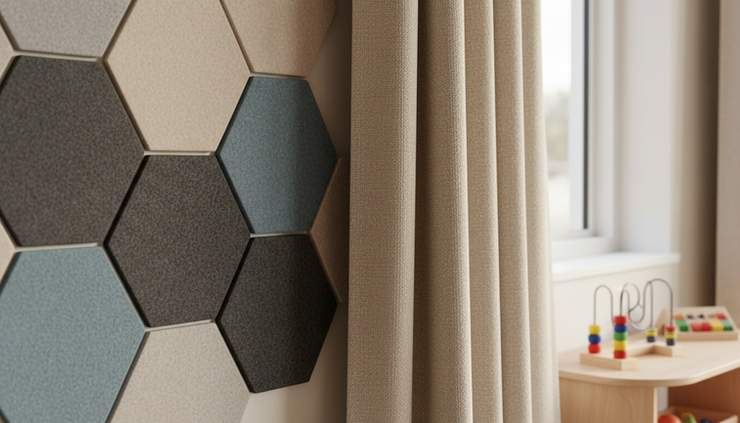
Soft materials help because they absorb sound rather than reflect it. Rugs, curtains, upholstered furniture, felt boards, fabric wall hangings, and acoustic foam panels can all reduce reverberation. Even small changes can make a room feel quieter, although the actual decibel level may not change much.
Unpredictable sounds can keep the brain on alert
Some sounds are hard because they are sudden rather than constant.
Examples include:
Doors slamming
Chairs dragging
Bells or buzzers
PA announcements
Sudden laughter
Dropped objects
Fire drills
Loud transitions
A blender, hand dryer, or pencil sharpener
Unpredictable sound can be especially difficult because the brain cannot settle into it. A constant low sound may fade into the background for some learners, but a sudden sharp sound can trigger a startle response and interrupt focus.
In classrooms and learning spaces, predictability helps. If a loud sound is expected, a simple warning can reduce stress. “The bell will ring in one minute” gives the brain time to prepare. For learners who are sensitive to sound, that small warning can prevent a larger reaction.
Sound dampening makes the whole room easier to process
Sound dampening means reducing reflection and harshness. It does not require a full renovation. The best changes are often practical and low-tech.
Start with the largest hard surfaces. Floors, walls, windows, and ceilings shape how sound moves through a room.
Helpful additions include:
Area rugs with non-slip backing
Curtains or fabric shades
Cork boards or felt boards
Soft seating
Fabric storage bins
Tennis balls or felt glides on chair legs
Acoustic foam panels in high-echo zones
Bookshelves with books or soft materials
Table mats during manipulative activities
A rug under a small-group table can reduce chair noise and foot movement. Curtains can soften window reflection. Felt glides on chairs can reduce the harsh scraping sound that interrupts many learners. Acoustic panels can help in corners or along walls where sound bounces.
The point is not to make the room look decorated. The point is to reduce the amount of sound the brain must sort.
A simple before-and-after check can help. Clap once in the room when it is empty. If the clap rings or lingers, the room has a lot of reflection. After adding soft materials, clap again. The sound should feel shorter and less sharp.
This is not a technical measurement, but it gives useful feedback.
Clear instructions reduce competing language
The auditory environment is not only the room. It also includes how adults speak.
When learners are already filtering noise, long verbal instructions can add another burden. Clear and direct language helps the brain find the important message.
Strong verbal directions are:
Short
Concrete
Sequential
Paired with a visual cue when useful
Given after attention is established
Repeated in the same wording if needed
Instead of saying, “Okay, everyone, before we move on, I need you to go ahead and put away what you were using, make sure your area looks the way it should, and then get ready for the next thing,” a clearer direction might be:
“Put the blocks in the bin. Then sit on the rug.”
That wording reduces language load. It also gives the learner fewer sounds to hold in memory.
For multi-step tasks, pause between steps. Let the learner complete the first action before adding the second. This is especially helpful in noisy rooms or during transitions.
Visual supports can also reduce the need for repeated speech:
Picture schedules
Written steps
Gesture cues
Color-coded bins
First-then boards
Simple checklists
Visual information should not replace human connection, but it can reduce the pressure on auditory processing. When the ears are tired, the eyes can help carry part of the task.

Managed background sound can help some learners
Silence helps some brains. Steady sound helps others.
For certain learners, a low, predictable background sound can support focus. White noise, brown noise, fan noise, or low-frequency rhythmic sound may reduce the contrast between small distracting sounds. It can create a steady auditory base that makes the room feel less jumpy.
Brown noise is often described as deeper and lower than white noise. Some people find it softer or less sharp. It should stay low in volume, steady, and predictable.
The key is to treat background sound as a tool, not a default.
Good background sound is:
Low volume
Consistent
Nonverbal
Easy to turn off
Used for a clear purpose
Monitored for signs of stress or distraction
Avoid music with lyrics during tasks that require thinking, reading, writing, listening, or memory. The brain naturally tries to decode words, even when the listener is not trying to sing along. That can pull energy away from the primary task, especially for learners who already work hard to process language.
Instrumental music may still be distracting for some learners if it changes tempo, volume, or mood. A steady sound is usually easier to process than a song with emotional shifts, sudden changes, or a strong melody.
A useful test is simple. Does the sound make the learner more settled, more focused, and more available for the task? Or does it add another layer the learner has to manage?
If the answer is unclear, try short trials. Use the same task with and without the sound. Watch attention, frustration, accuracy, and recovery time. The learner’s behavior gives better information than adult preference.
A sound plan should include quiet options
Some learners need a place where sound drops away. A quiet option does not have to be a separate therapy room. It can be a corner, a reading nook, a small tent, a hallway bench during low-traffic times, or a calm area with soft materials.
A successful quiet space should feel accessible, not like punishment. It should be available before overload becomes a crisis.
Helpful quiet-space features include:
Soft seating
Reduced visual clutter
Minimal background noise
Clear expectations
Simple calming tools
Optional noise-reducing headphones
A predictable way to request use
Noise-reducing headphones can help, but they are not the whole solution. Some learners love them. Others dislike the pressure or feel more aware of internal body sounds while wearing them. They should be offered thoughtfully and never used as the only support for a loud environment.
A quiet option works best when adults teach how to use it. A learner might need a card, gesture, or phrase such as “quiet break.” The break should have a clear return plan, such as a timer, a visual cue, or one completed regulation activity.
Build a practical sound audit into the routine
A sound audit does not require special equipment. It requires attention and honesty.
Walk through the environment at different times of day. Listen during arrival, instruction, small groups, independent work, lunch, transitions, and cleanup. The sound profile may change dramatically.
Use these questions:
What sounds compete with speech?
Where does echo feel strongest?
Which sounds are sudden or unpredictable?
Where do learners cover ears, leave the area, or lose focus?
Which directions are most often missed?
Which parts of the day lead to fatigue or frustration?
What sound can be reduced, softened, moved, or made predictable?
Then choose one change at a time. Do not change everything at once unless the environment is clearly overwhelming. Small changes are easier to observe.
A useful sequence might be:
Reduce the most obvious competing noise.
Add soft materials where sound reflects.
Shorten and clarify verbal instructions.
Add visual supports for repeated routines.
Test quiet, low-level background sound if appropriate.
Create or improve a quiet break option.
Watch for changes in attention, frustration, and recovery.
The best sound plan is responsive. It changes based on the learner, the task, and the time of day.

Clear sound supports better regulation and learning
A neuro-rich environment does more than add sensory tools. It reduces unnecessary barriers so the brain can focus on connection, communication, and learning.
Sound is one of the easiest barriers to overlook because adults often normalize it. A fan hums. A chair scrapes. A hallway echoes. A voice competes with ten other sounds. Each one may seem small, but together they can create a heavy processing load.
Better auditory design starts with one question:
What does the brain have to filter before it can understand?
When the answer is “too much,” the next step is clear. Reduce competing noise. Soften echo. Make sound predictable. Give instructions in clean, direct language. Use steady background sound only when it helps. Offer quiet recovery before fatigue becomes shutdown.
The room does not need to be silent. It needs to be understandable. Clearer sound gives the brain more room for focus, learning, and calm participation.
Take a free auditory processing test:
To find out more about auditory processing.
Visit auditoryapp.one to increase daily auditory sequencing.
If you want to know more about the mechanics of auditory processing, take our Auditory Processing course on Skool: Begin Again International
Join our next Brain Training Workshop: https://tidycal.com/10yw9q3/brain-training


Comments